The Secret Language of Plants:
The Mystical World of Plant Communication and How Your Garden Holds Secret Conversations
The Secret Chat Happening in Your Garden Right Now
When you step outside into your garden, a million conversations are unfolding right before your eyes. But you can't hear it or see it unless you know where to listen. Plants are exchanging vital resources, sending out warnings to each other, and nudging their neighbors to grow stronger or to reach for the sunlight a little more. They use underground fungal networks, chemicals carried on the breeze, and secret signals sent out by their roots to keep in touch. Plants have been having these conversations for millions of years. The more scientists pay attention, the more astonishing the details turn out to be.
If you're a gardener, especially one who's dreaming of a food forest or a garden that takes care of itself, then this changes everything. Those plants in front of you aren't just standing there on their own; they're part of a whole lively community, working together, competing, but always connected. What's really going on down there in the soil and swirling through the air? Let's dive into the Wood Wide Web (that's the mycorrhizal fungi), airborne plant warnings, root-to-root messages, and how all this can help you grow a healthier, more resilient garden that doesn't need you hovering over it every day.
The Wood Wide Web: The Mycorrhizal Fungi Network in Your Soil

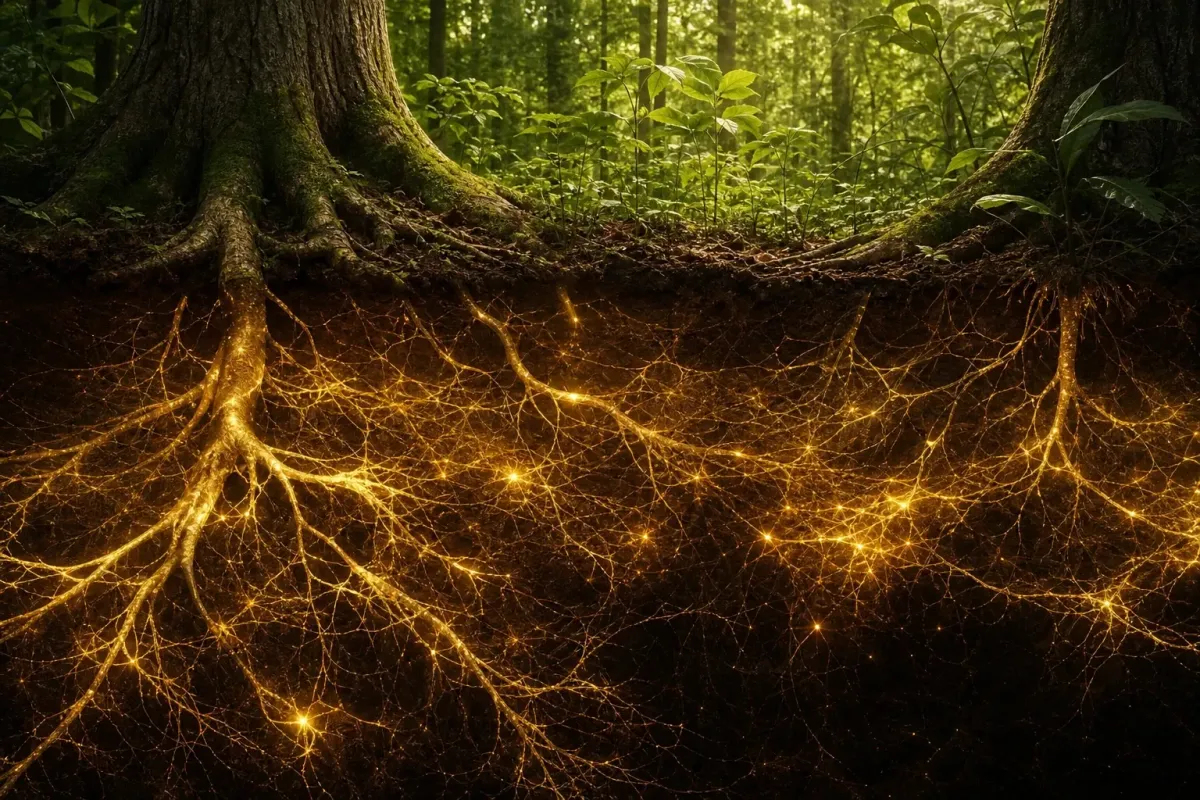
Beneath any healthy patch of soil, there lies a network of mycorrhizal fungi. These microscopic threads are mycelium, and their mycelial networks weave through the soil, connecting plant roots and root systems in a web of life that would surprise you. Call it the mycorrhizal network, or, as some writers and journalists have started calling it, the Wood Wide Web. It's a fitting name, because through this network, trees and plants exchange nutrients, water, and chemical signals. And it's not all one way. These symbiotic relationships also move carbon underground. An older, established tree will send sugars to a young seedling growing in its shade. Not by accident, but deliberately, in response to the seedling's need. Many of these fungi also feed on organic matter in the soil, supporting the broader environment around them. As that material breaks down, it becomes a food source for other life in the soil ecosystem.
Forest ecologist Suzanne Simard made a remarkable discovery: the oldest and largest trees in a forest are the main hubs in this underground network. She calls them mother trees. These wise old trees can actually recognize their own offspring through their roots and send extra support their way. Yes, you read that right: a tree is feeding its children, right down through the soil. If that doesn't change the way you see your garden, then read that bit again. Not every plant connects in exactly the same way, though. Current research shows that specific species of fungi often pair with particular plant species, shaping how mycorrhizal networks link some plants more closely than others.
Chemical Signals in the Air: Volatile Organic Compounds and the Plant Language You Can't Even Hear
But the plant conversation doesn't stop underground. When a hungry insect starts munching on a plant, plants send a chemical warning through the air: tiny airborne messages called volatile organic compounds, or VOCs. These chemicals are produced by damaged tissues and can influence gene expression in nearby plants. Nearby plants, especially those of the same kind, pick up the warning and get ready. For example, tomato plants warn their neighbors when they're under attack, and neighboring plants detect these volatile cues and prepare defense mechanisms before damage reaches them. Within minutes, those neighbors start making their leaves taste bad, or even a little toxic to the bugs. They don't have to wait to be bitten. They get a heads-up and prepare, thanks to their plant friends. Scientists have seen this in corn, tobacco, lima beans, sagebrush, and many more, showing that many plants communicate this way and that insects respond to these signals too. And it turns out this kind of plant-to-plant warning system is not rare at all. It's one of the main ways plants communicate and watch out for each other.
Calling for Help

Some plants go a step further. When a caterpillar starts munching on a tomato plant, the plant releases a special blend of chemicals into the air. These signals don't just warn the neighbors - they call in the reinforcements. Parasitic wasps, which are natural enemies of caterpillars, pick up the scent and swoop in to help. So a tomato plant - with no brain, no nerves, and no way to run away - has figured out how to identify its attacker and call for exactly the right kind of help.
Flowers also use chemical signals to attract pollinators and other beneficial insects.
It's not just about defense, either. Some plants, like the parasitic Cuscuta pentagona, can actually use VOCs to locate tomato plants as their favorite hosts. Plants have been pulling off this trick for a long, long time, communicating with other organisms in ways that can shape plant behavior, before humans even thought to plant a garden.
Root Conversations: How Plants Talk Through Their Plant Roots
Roots have their own secret language, a way of communicating with neighboring plants as well as friendly microbes, fungi, and the world around them. They release chemicals into the soil. These root exudates send all sorts of messages to nearby plants, friendly soil microbes, and fungi. Take pea plants, for example. They can pass along stress signals through their roots, letting their neighbors know when things are tough.
And some of those root messages are all about working together. A plant might send out compounds that encourage helpful bacteria and fungi to hang out by its roots, and in return, those microbes support growth and help with hormones and disease resistance below ground. These underground chats can be a real lifeline for plants that are struggling. For example, when plants face drought, low water availability can trigger these signals and help nearby plants conserve water.
But it's not all about being best friends. Some plants release chemicals that keep other plants from getting too close. This is called allelopathy, and it's one reason why who you plant next to what matters so much in a food forest. Take black walnut trees for example. They give off a chemical called juglone that's toxic to loads of plants, so you need to plan around them with care. On the flip side, plants like comfrey, yarrow, and clover send out compounds that make the soil better for everyone around them. That's why we use them in plant communities. Intentional communities of plants that help each other out form the backbone of a thriving food forest.
What This Means For Your Garden
When you plant a food forest, you're not just putting plants in the ground; you're creating a whole community that's going to start chatting with each other. The more diverse the mix of plants, the more interesting their conversations are going to be. And it's not just about chemical messages. Plants also send electrical signals through their tissues, with signals moving through cells in leaves, stems, and roots as shifts in electric charge, like plant-sized text messages. Plants’ electrical signals work in two ways: an action potential is either fully activated or not activated at all, while a variation potential can set off several of these signals in a row. With resting membrane potentials of about -80 to -200 mV, they can support rapid stress responses. These signals help them figure out how to react when things get tough. And by the way, calcium plays a starring role in all this. It's like the plant messaging service.

The more species you have in a food forest, the more signals and relationships and mutual support you get, because different living things in nature, including plants, fungi, animals, and other organisms, respond to light, stress, and one another in ways that matter for agriculture and climate change. A mundane old lawn is pretty quiet. But a food forest is buzzing with life and plant chat.
That's why once its established, a food forest needs so much less fussing over than a regular garden. You're not trying to solve every problem for them. They're working things out between themselves, sharing resources, warning each other about trouble, and just generally looking out for each other.
Some plants even make tiny clicky sounds when they're stressed, and moths will listen in and think, "Ahh, that sounds like a good place to lay my eggs." And did you know that researchers have recorded young maize roots producing clicks at about 220 Hz too? Your job isn't to be the plant dictator. Your job is to set up a community that makes sense, and then let it get on with doing what healthy communities do best.
If this idea resonates with you and you want to explore it further, I'd love to have a chat. A Food Forest Possibility Session is a free conversation where we take a look at your land, your vision, and the very first steps towards creating an ecosystem that communicates, cooperates, and produces plenty for your family for years to come. Book your session with me here: https://api.leadconnectorhq.com/widget/bookings/lynnsstrategy-calendar
Your garden is already eavesdropping on these conversations. Now let's give it something worth listening to.


